

Step 7: Training — ACT Command
Before running
- Environment: you need to first set up the environment and upload the dataset to the cloud GPU as described in Cloud GPU training environment setup. ACT comes with the basic LeRobot environment, so no extra installation is needed
- Dataset:
--dataset.root=~/lerobot_my_dataset_shake_handsin the command points to the handshake dataset collected in step 6. If you are training your own task, replace it with your own dataset name - Output directory: if
--output_diralready exists, it will directly raiseFileExistsError; use a new directory name, or add--resume=trueto continue training - You can check the curves on wandb at any time during training, see View real-time training curves on wandb
Reference documentation
https://github.com/huggingface/lerobot/blob/main/src/lerobot/scripts/lerobot_train.py
https://github.com/huggingface/lerobot/blob/main/src/lerobot/configs/train.py
Why start with the ACT algorithm
ACT is the first model most recommended for training when playing with LeRobot. Its advantages are as follows:
The model is very lightweight, with only eighty million learnable parameters
Training converges very quickly, and inference is also very fast
You can see results after training for one hour on a single GPU
The ACT model itself is very small; the archive is about 200MB, which makes it very easy to store and transfer. The model archive produced by training is about 300MB (see the end of this page)
Collecting about 30 episodes of data for the dataset is basically enough
It can be deployed for inference on an Ubuntu host, a Mac computer, a Windows computer, or even a Raspberry Pi
The inference results on a real robot are still quite good, which is enough for simple tasks like grabbing, shaking hands, and placing a pen
The ACT algorithm is already included in the basic environment of the LeRobot library, so no other libraries need to be installed
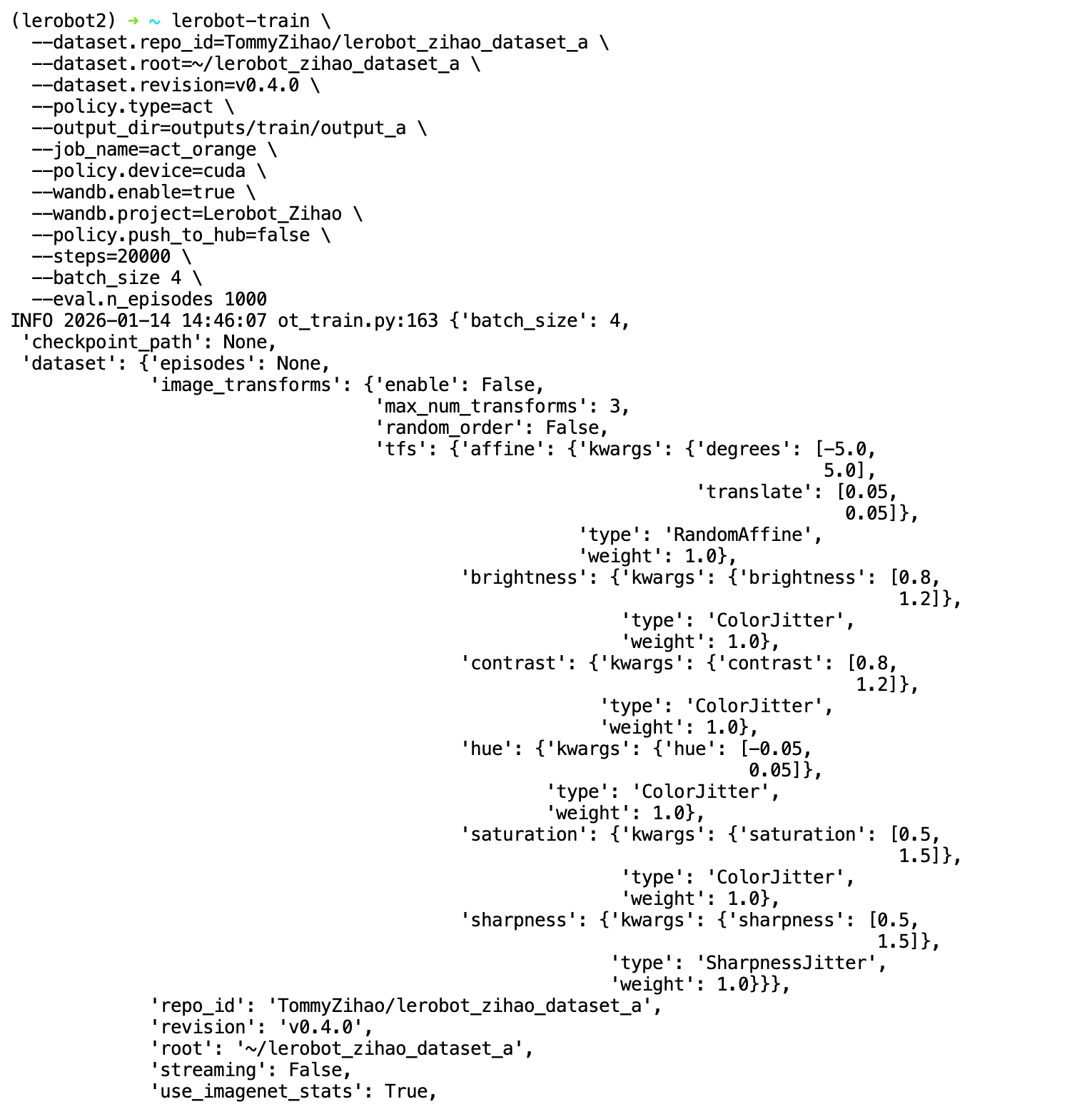
Command line
lerobot-train \
  --dataset.repo_id=<username>/lerobot_my_dataset_shake_hands \
  --dataset.root=~/lerobot_my_dataset_shake_hands \
  --dataset.revision=v0.1.0 \
  --dataset.streaming=false \
  --policy.type=act \
  --output_dir=~/output_lerobot_train/shake/act/ \
  --job_name=shake_act_a \
  --policy.device=cuda \
  --wandb.enable=true \
  --wandb.project=Lerobot_my_Project \
  --policy.push_to_hub=false \
  --steps=20000 \
  --batch_size=8
Command line reference
The line-continuation character `` can only have one space before it and no space after it
| Command line parameter | Description |
|---|---|
| --dataset.repo_id | The Repo_ID of the HuggingFace dataset, in the form 用户名/数据集名 |
| --dataset.root | The local path of the dataset. When the dataset has already been downloaded locally, it should point to the actual directory |
| --dataset.revision | The dataset version, which was specified when uploading the dataset to HuggingFace |
| --dataset.streaming | Whether to read in a streaming manner. When the dataset is local, set this to false, as streaming reads are not needed |
| --policy.type | The algorithm to train, such as act, smolvla, diffusion, pi0, pi05, pi0_fast, wall_x |
| --output_dir | The directory where the training output is saved |
| --job_name | The name of this training job |
| --policy.device | The compute device |
| --wandb.enable | Enable wandb visualization |
| --wandb.project | The wandb project name |
| --policy.push_to_hub | Upload the trained model to the HuggingFace cloud |
| --steps | The number of training steps |
| --batch_size | The amount of data fed in per step; if VRAM is insufficient, it should be reduced |
Training process
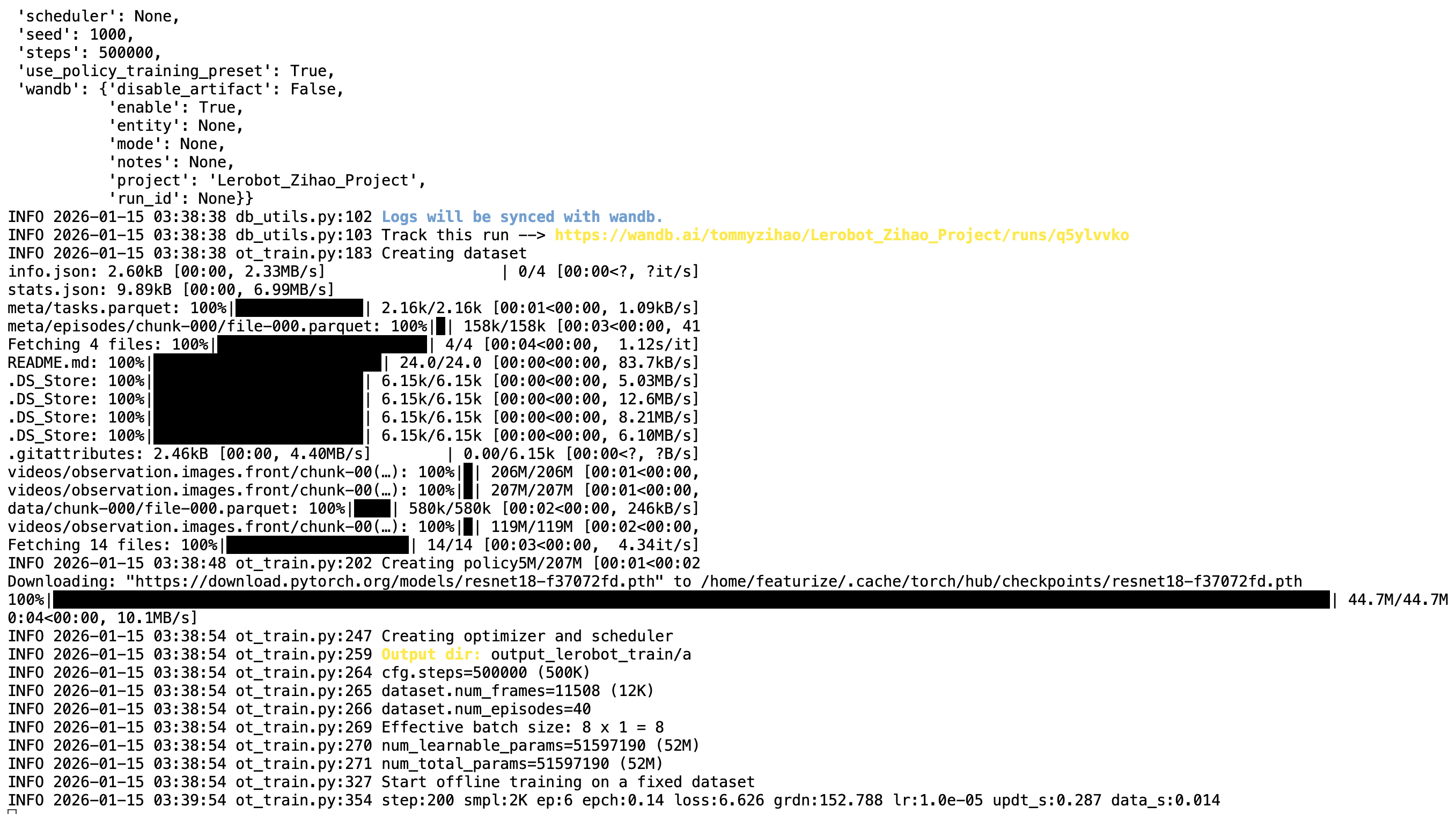
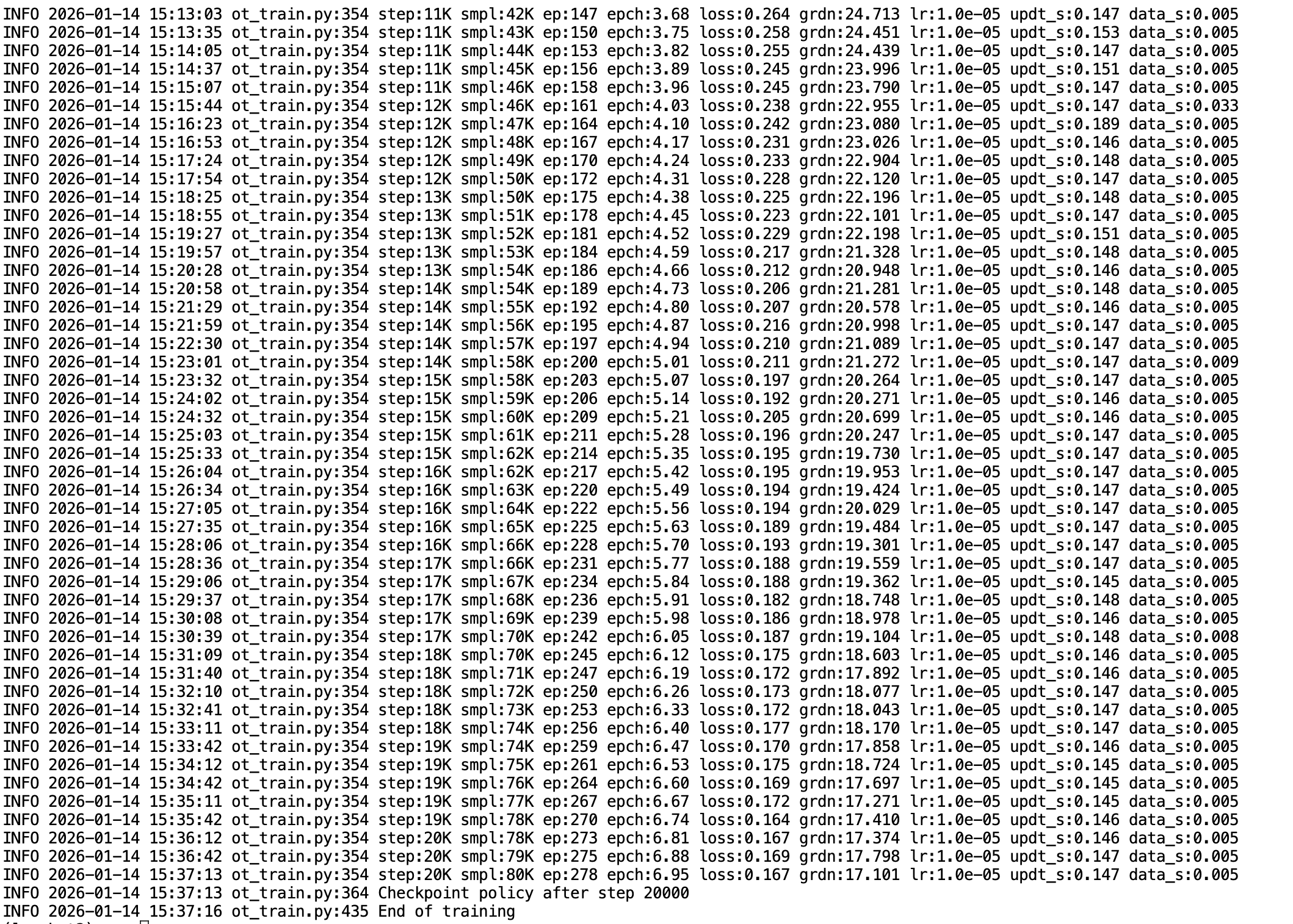
The model archive is about 300MB